"How much does it cost?" sounds like a simple question, but AI chatbot prices are surprisingly hard to compare. One tool charges a flat monthly fee, another charges per team member, another per conversation the AI resolves. Two tools with the same headline price can end up costing very different amounts once your website gets busy.
This guide explains how AI chatbots are priced, shows real costs from public pricing pages (checked in October 2026), and gives you a simple way to estimate your own monthly bill.
The short answer
For a small business, an AI chatbot typically costs:
- $0 on a free plan, if your volume is low and you can live with the limits.
- About $19 to $50 a month on a flat plan that includes AI replies.
- $150 to $650+ a month with tools that charge per seat, per AI resolution or per conversation, once you have a few hundred chats a month.
The difference comes almost entirely from how the tool charges for AI, not the headline price.
The five ways AI chatbots are priced
1. Flat plans with AI included
You pay a fixed monthly price, and the plan includes an allowance of AI replies (often called message credits). Chatloom works this way: $19 a month on Starter with 2,000 message credits, or $49 on Pro with 5,000.
- Good: predictable. You know the bill before the month starts.
- Watch: check how many replies the allowance really covers, because more capable AI models usually use more credits per reply.
2. Per seat (per team member)
You pay for each person who answers chats. LiveChat starts at $19 per user a month (billed yearly), Intercom at $29 per seat, and Zendesk at $19 per agent, with live chat from $55.
- Good: fair if your team chats with customers all day.
- Watch: the AI is often limited or charged separately on top of the seats.
3. Per AI resolution
You pay each time the AI fully resolves a conversation. Intercom's Fin charges $0.99 per outcome, and Zendesk charges $2.00 per automated resolution after a few included ones.
- Good: you only pay when the AI does the job.
- Watch: the busier you get, the bigger the bill, and it's hard to predict.
4. Per conversation, plus AI usage
Some platforms charge by the number of conversations and add the AI's own costs on top. Botpress's Plus plan, for example, is $150 a month (billed yearly) for 250 conversations, with extra conversations at $65 per 100.
- Good: flexible for custom projects.
- Watch: two meters (conversations and AI usage) make budgeting harder.
5. Built for you by an agency or developer
A custom chatbot built by a developer or agency usually has a setup fee plus monthly hosting and AI costs. It makes sense for unusual needs, but it's rarely the cheapest route for a small business website.
What it really costs: three examples
Here's what the same amount of work costs with different pricing models, using each company's public prices in October 2026. "Resolved" means the AI answered without a person.
| Your situation | Flat plan (Chatloom) | Per seat + per resolution | Per conversation |
|---|---|---|---|
| One person, 300 AI-resolved chats a month | $49 (Pro) | Intercom: about $326. Zendesk: about $645 | Botpress Plus: $150 (250 included) plus a pack of 100 at $65: $215 |
| Three people, 300 AI-resolved chats a month | $19 to $49 | LiveChat Growth: about $336 | Botpress Plus: $215 |
| A quiet website, 50 chats a month | $0 to $19 | From $19 to $55 a month per person, plus any resolutions | Free plan (100 conversations) |
Prices change, so check each company's pricing page before you decide. Our honest comparisons show the details for each tool.
The hidden costs to check
The headline price is only part of the bill. Before you sign up, check for:
- Removing the tool's branding. Some tools charge extra (Chatbase, for example, lists it as a $99/month add-on), others include it on a higher plan.
- Extra team members. Plans often include a few seats, then charge for each extra person.
- AI add-ons. Some tools sell the AI agent separately from the live chat plan.
- Overages. What happens when you run out of AI replies? Some tools charge automatically; others (including Chatloom) pause until your allowance resets, so you're never billed by surprise.
- Your own time. Setting up a good chatbot takes about an hour, and keeping it accurate takes ten minutes a week.
How to estimate your own bill in five minutes
- Count your questions. Look at the last month of emails, calls and messages that asked a question your website could answer. That's a rough idea of your monthly chats.
- Estimate replies per chat. Most customer chats take two to four AI replies.
- Multiply. Chats × replies gives you the AI replies you need each month.
- Check each tool against that number, including seats and add-ons, not just the headline price.
- Start on a free plan or trial, then look at real usage after a few weeks before you upgrade.
Is it worth it?
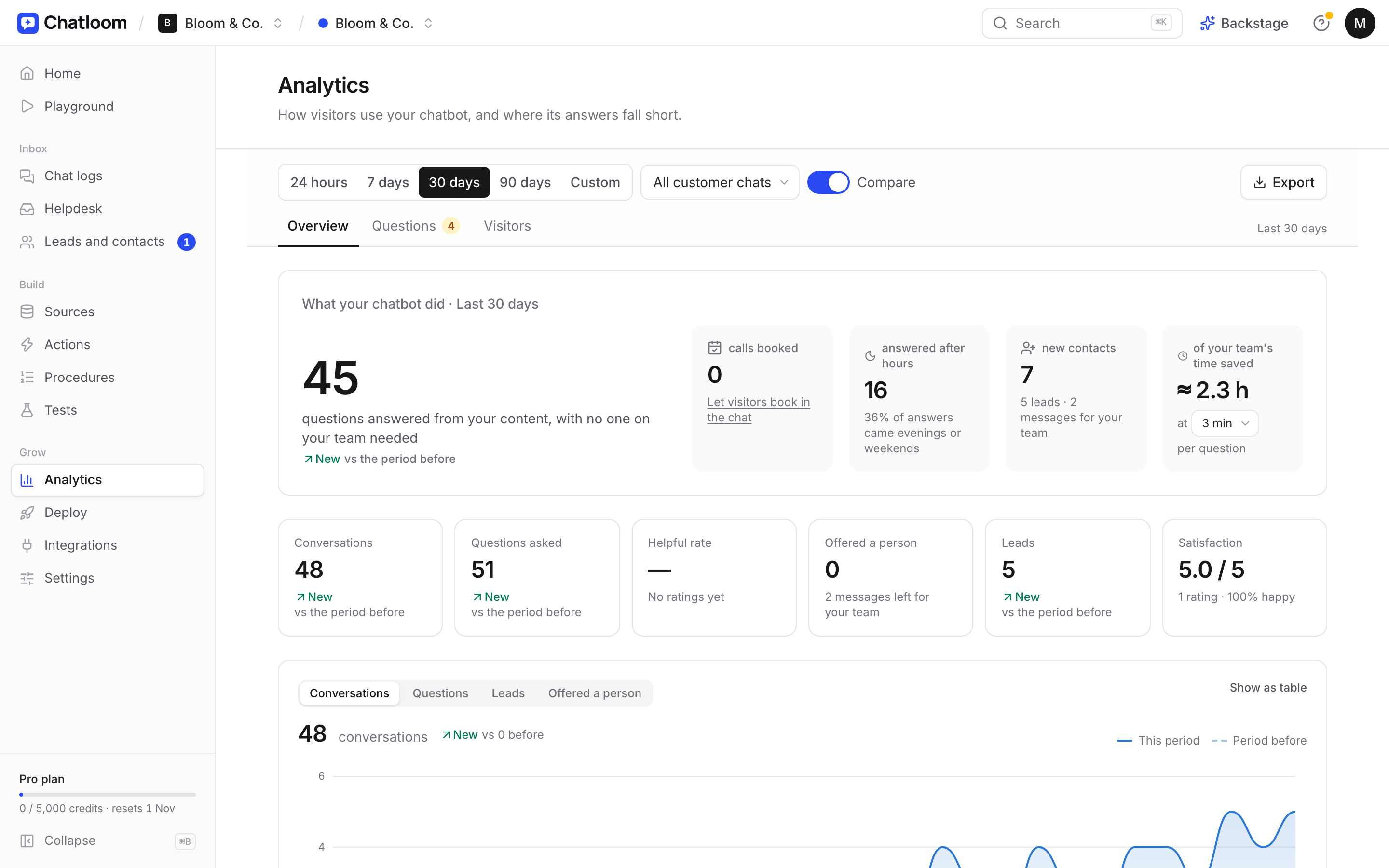
It depends on what an unanswered question costs you. A simple way to think about it: if the chatbot helps you win even one or two extra customers a month, or saves your team a few hours of repeating the same answers, a $19 to $49 plan usually pays for itself. Measure it: a good chatbot shows how many questions it answered without you, how many came after hours, and how much time it saved.
If you're ready to try one, our step-by-step guide walks you through setting it up in an afternoon.
Questions
Is there a free AI chatbot for small businesses?
Yes. Several tools have free plans. Chatloom's free plan includes 100 message credits a month for one chatbot, which is enough to test properly on a quiet website. Others offer free live chat with little or no AI.
Why do some chatbots charge per resolution?
Because the AI's work is what you're paying for. It can be fair at low volume, but the bill grows with every conversation, which makes it harder to budget for a busy small business.
What happens if I use more than my plan includes?
It depends on the tool. Some charge for extra usage automatically. Chatloom pauses AI replies until your allowance resets (visitors can still leave a message for your team), and warns you before you run out, so there are no surprise charges.